Blog

  • Self-Awareness in Athletes

    Self-Awareness in Athletes

    Author – Vedika Jogani

    A recent graduate from Ithaca College with a Master’s degree in Sports and Exercise Science, specializing in Mental Performance, Vedika Jogani is OMP’s Product and Content Manager. During her studies, Vedika worked closely with Ithaca’s Men’s and Women’s Tennis Teams and Women’s Volleyball Team as their Mental Performance Consultant. Vedika is currently completing her Certified Mental Performance Consultant Certification.


    Ever marveled at how top-tier athletes seem to possess an innate understanding of their game, effortlessly pinpointing their strengths and areas for improvement?

    This exceptional ability finds its roots in the realm of self-awareness.

    In sport, it’s not merely about acknowledging one’s physical capabilities; it’s about a profound connection with oneself.

    Self-awareness goes beyond the surface, involving a keen sense of self-monitoring, emotional regulation, and behavioral correction.

    Athletes who are truly self-aware aren’t just attuned to the beats of their bodies; they are intimately connected with their mind. This mental sharpness empowers them to focus sharply, handle stress with grace, and make lightning-fast decisions, setting them apart as true champions in their field. 

    Professional athletes have wholeheartedly embraced the power of journaling as a tool for self-reflection, propelling them toward peak performance. Take tennis legend Serena Williams, for instance, who relies on journaling to cleanse her mind of negative thoughts and emotions.

    Likewise, Irish track and field Olympian Roisin McGettigan attests, “I could track my progress, discern what strategies yielded results, and identify areas needing improvement. It became my compass, revealing if I overestimated my training or missed crucial signs of fatigue.” 

    In the expansive realm of sports psychology, research illuminates the transformative impact of self-awareness. It sharpens focus during high-stakes games and rigorous practices, fostering an intrinsic motivation that propels athletes toward personal growth.

    This heightened self-awareness isn’t just a mental exercise; it’s a game-changer, enhancing cognitive abilities and shaping behaviors. Athletes in tune with their inner selves exhibit exceptional clarity and control over their thoughts, empowering them to navigate challenges with unyielding resilience.

    Through the art of journaling, these athletes craft a path to excellence, transcending the physical arena to conquer the mental and emotional facets of their athletic journey. 

    Practices that help build self-awareness:

    1. Mindfulness Meditation: Engage in mindfulness meditation practices. These exercises encourage you to focus on the present moment, your thoughts, and your emotions without judgment. Regular practice enhances your ability to observe your thoughts and feelings objectively, fostering self-awareness. 
    1. Journalling and Check-Ins: Start a journal where you jot down your thoughts, emotions, and experiences. Writing allows you to reflect on your day, your reactions, and your decisions. Over time, patterns in your behavior and emotions become clearer, aiding in self-discovery. 
    1. Seek Feedback: Ask for feedback from trusted friends, family, teammates and coaches. Sometimes, others can provide insights about your behavior and attitudes that you might not have noticed. Be open to constructive criticism; it’s a powerful tool for self-awareness. 

    Cultivating self-awareness is an intricate journey that matures with time and practice. Explore the nuances of journaling strategies with the guidance of Dr. Andrea Wieland through the OMP app and immerse yourself in guided meditations crafted by world-renowned sports psychologists and mental performance coaches.

    Remember, take a moment to check in with yourself, reflecting on your performances as a pivotal step toward profound self-awareness and personal growth. 
  • Lutz’s Second Chance a Lesson in Mental Preparation

    Lutz’s Second Chance a Lesson in Mental Preparation

    Author – Vedika Jogani

    A recent graduate from Ithaca College with a Master’s degree in Sports and Exercise Science, specializing in Mental Performance, Vedika Jogani is OMP’s Product and Content Manager. During her studies, Vedika worked closely with Ithaca’s Men’s and Women’s Tennis Teams and Women’s Volleyball Team as their Mental Performance Consultant. Vedika is currently completing her Certified Mental Performance Consultant Certification.


    In the NFL, every second counts and players find themselves facing unexpected challenges that test not only their physical capabilities but also their mental resilience.

    Monday night’s Broncos vs Bills game provided a prime example of how mental fortitude plays a key role in a high-pressure position of a kicker.

    The Broncos’ quarterback Russell Wilson takes a knee, and in a split second, the kicking team rushes onto the field.

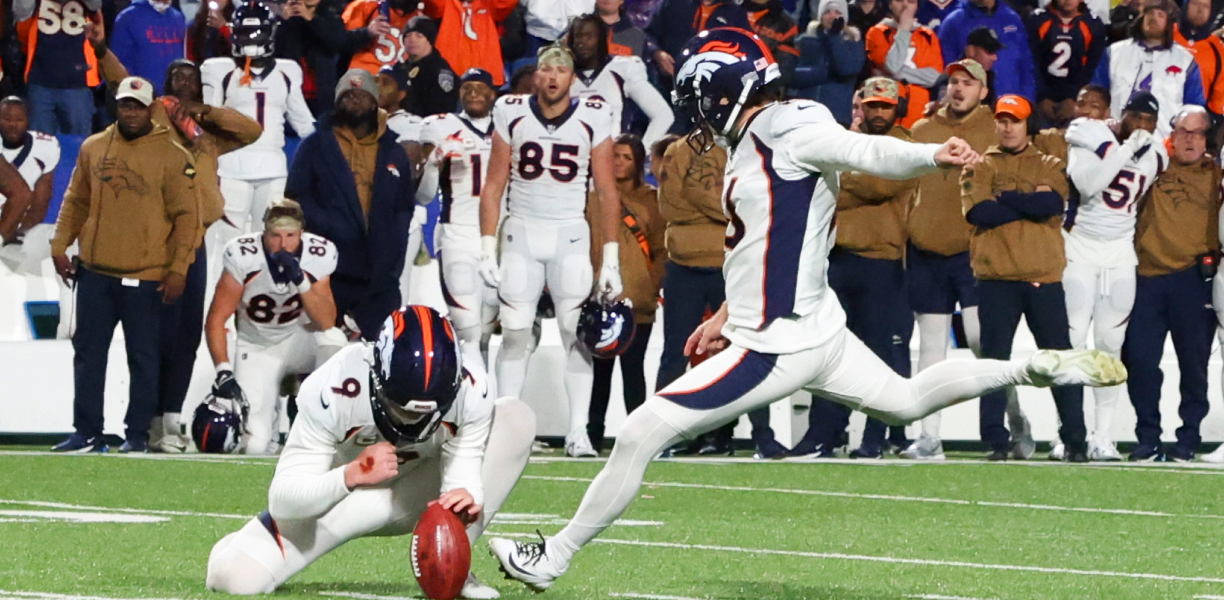
    Wil Lutz, the kicker, lines up for a crucial kick that will win the Broncos the game. The tension is palpable. Lutz kicks, and to everyone’s surprise, he misses.

    But the drama doesn’t end there. Buffalo, in their attempt to defend against the initial kick and because of how quickly the Broncos have rushed their kicking team onto the field, has 12 players on the field, resulting in a penalty. Lutz gets a second chance to kick, this time from 5 yards closer.

    Kicking is as much a mental skill as it is physical one. It’s not just about the strength of the leg but also about the clarity of the mind. 

    Now, imagine the pressure of having to rush onto the field amidst the chaos. How does a kicker prepare mentally when put into the spotlight with only a little time to spare?

    This is when the art of mental preparation becomes paramount. Using these skills can allow athletes to prepare for quick on-field transitions:

    1. Visualization and Focus: Mentally rehearsing the scenario where they need to rush on the field, line up for a kick and block out distractions can allow them to build a blueprint for success. Maintaining unwavering focus amidst the chaos becomes a crucial aspect of mental training. 
    1. Controlled Breathing Techniques: Taking deep, intentional breaths can help athletes regulate their heart rate and stay calm under pressure. This simple but effective technique can become an anchor providing a moment of clarity in a high-pressure situation.
    1. Pre-established Routines: Having a pre-kick routine can act as a mental safety net. Kickers develop rituals – from the way they approach the ball to the specific steps they take before the kick. These routines serve not only as physical preparation but also as a mental cue, providing a familiar and calming rhythm even in the most hurried situations 
    1. Mindfulness Practices: Incorporating mindfulness into their training regimen can help kickers stay present in the moment. Mindfulness techniques, such as meditation and awareness exercises, enable athletes to let go of distractions, focus on the task at hand, and navigate the on-field hustle with a clear mind.

    Then comes the missed kick. It’s a situation that every athlete dreads. The true test lies in the ability to rebound.

    Lutz found the mental strength to reset and repeat the action allowing him to be successful the second time over. Athletes can prepare themselves to repeat an action they’ve just failed at. 

    1. Reframing the Narrative: Rather than viewing the mistake as a failure, athletes can reframe it as a learning experience. What went wrong, what can be adjusted. Having a growth mindset allows for continued success. 
    1. Resetting and Reestablishing Focus: Athletes can use specific rituals and focus cues to symbolize a fresh start. This can include visual or auditory cues that remind athletes to refocus on the task at hand.
    1. Confidence building strategies: Using positive self-talk and reminding yourself of past successes can help to regain your confidence and perform your task successfully.

    Athletes often train not just their bodies but their minds to overcome setbacks. They develop mental routines, techniques, and coping mechanisms to navigate the emotional rollercoaster of success and failure.

    Whether it’s a missed kick, a fumble, or a strikeout, the ability to shake off the disappointment and focus on the next opportunity is what separates great athletes from the rest. 

    In the end, Lutz successfully converted the second kick, turning a potential low point into a triumphant moment.

    His mental fortitude and ability to navigate the unexpected serve as a valuable lesson for athletes in any sport.

    The game is not just played on the field; it’s equally a battle within the mind. 

  • The Mental Skills Behind Maxwell’s Miraculous Knock

    The Mental Skills Behind Maxwell’s Miraculous Knock

    Author – Vedika Jogani & Ryan Miller

    A recent graduate from Ithaca College with a Master’s degree in Sports and Exercise Science, specializing in Mental Performance, Vedika Jogani is OMP’s Product and Content Manager. During her studies, Vedika worked closely with Ithaca’s Men’s and Women’s Tennis Teams and Women’s Volleyball Team as their Mental Performance Consultant. Vedika is currently completing her Certified Mental Performance Consultant Certification.

    Ryan Miller is an award-winning Journalist, Broadcaster and Photographer, and OMP’s Head of Content.


    It’s the bottom of the 9th inning. You’re on the road and it’s a playoff game. The series is tied. Your team is trailing by three. Bases are loaded. You’re at the plate and you’re already 0-2 and you’ve struck out at all of your at-bats so far. Add to this you can’t use your legs as you’re just run a half marathon. You hit a bomb and win the game.

    Imagine you’re at the FIFA World Cup. Your team is trailing by two goals. Due to sending offs and injuries you’re down to nine players on the pitch, and you’re so fatigued your legs are seizing up. There’s just 90 seconds on the clock. Somehow you score a hatrick.

    Those are improbable feats; some may say impossible.

    Kirk Gibson’s walk off home run in game one of the 1988 World Series is probably the closest, but he was pinch hitting. From a soccer perspective Lucas Moura’s Champion’s League Hatrick in the 2021 Semi-Final springs to mind, but his team was still at full strength. What Gibson and Moura did had been done before.

    What Australian Glenn Maxwell did on Tuesday night at the Cricket World Cup in India beggars’ belief. His innings was the first of its kind.

    He single-handedly won his team the game. He scored 68.8 per cent of his team’s total.

    He did all this while being barely able to stand, let alone walk, due to debilitating cramps in both legs and a back spasm.

    When he started his innings, Australia stood just a six per cent chance of winning.

    While his 201 not out was a sensational display of physical skill, it was a stunning display of resilience, concentration and determination, and perhaps the best example of being in a flow state from an athlete.

    Resilience

    What made Maxwell’s innings truly exceptional was not just the staggering number of runs he scored but the incredible resilience and unwavering focus he displayed throughout.

    Despite battling debilitating cramps that at one stage had him on the ground spasming as his muscles filled with lactic acid, he continued to stand and deliver physically.

    His ability stare down insurmountable odds and physical limitations is a shining example of resilience in sport. No matter how many times he got knocked down, he continued to get up.

    It was clear during his performance – and Maxwell alluded to it in a post-performance interview – that he had a plan and a goal to stick to.

    Having a clear goal, sense of purpose, or a “why” allows athletes to draw upon it as inspiration, motivating them to continue even if their body is telling them to stop.

    Using What Resouces He Had

    Cricket is a technical game, especially batting. Like Golf, Baseball and Hockey, batting in Cricket requires the full use of the body. Feet moving towards the ball, shoulders swinging through, wrists and hands turning the bat to ensure its middle meets the ball.

    Maxwell could not use his feet. He could barely bend his back.

    So, he stood tall and used one of the resources that he still had – the power of his wrists. He also fell back on what he had practiced in training.

    “I’ve done it before. When I get into a really nice rythm I feel like I don’t need to use a lot of foot and body movement,” he said after.

    “You do no-foot drills working on your hand speed, but I guess I was just trying to find a ball I could hit for a boundary knowing I wasn’t going to be running ones and twos.”

    This is a key mental skill when under pressure or facing adversity – acknowledging the plight you find yourself in and coming up with solutions to the problems you face, rather than just giving up. What resources do you still have that can help you perform?

    Controlling the Game

    Throughout his innings Maxwell was never rushed or panicked. This is because he took control of the game. Cricket is a combination of a closed and open skilled sport.

    Open skilled sports are performed in a dynamic and changing environment, while closed skills take place in a predictable and static environment.

    While Maxwell could never predict or control what his opponents were going to do to try and get him out, he could control the flow of the game.

    Instead of rushing to face each ball, he took time to free his mind, allowing his attentional focus to drift, before settling himself to concentrate at the task at hand. Controlling the flow of the game not only gave him mental breaks but also allowed him physical breaks too – giving his body valuable moments of rest.

    Being able to find moments to let your mind wander during a performance is key – you cannot possible concentrate every second of every performance. Humans are hardwired to be distracted, so it is better for athletes to find moments within their performance when they can be distracted rather than getting distracted when they need to be focused.

    Flow State & The Power of Belief

    In his post-match interview, Maxwell revealed the secret behind his extraordinary performance – simplicity.

    “I wasn’t overthinking the situation, I just knew that if I got a ball I could hit, I’d try to hit it,” he said.

    He trusted his experience and instincts, allowing the rhythm of the game to take over. This mental state, often referred to as ‘flow,’ transformed his every move into poetry in motion. Every boundary, every six, and every calculated risk seemed effortless, a testament to his mastery of the game.

    What is also notable in this quote is Maxwell’s state of mind during the innings. At no point did he doubt his own ability. He knew he had the ability to score runs regardless of the situation. The power of self-belief and having confidence in your abilities is a key skill in being able to perform in not just pressure situations but all situations. If you know you can and believe that you can, you can.

    Learn more about getting into a flow state here.

    Joys of the Game

    What truly set Maxwell’s innings apart was his ability to find joy in the midst of physical turmoil. He described the experience as ‘great fun,’ emphasizing the camaraderie he shared with his teammate Patty Cummins. Their partnership wasn’t just a display of exceptional cricketing skills; it was a celebration of the sport, a reminder that amidst the fierce competition, there’s room for camaraderie and genuine enjoyment.

    This innings will echo through cricketing history as more than just a remarkable achievement; it will be remembered as a lesson in resilience, determination, and the sheer love for the game. Maxwell’s audacious spirit and unyielding confidence didn’t just win a match; they won the hearts of cricket enthusiasts worldwide.

  • Psychologically Safe Environments

    Psychologically Safe Environments

    Author – Vedika Jogani

    A recent graduate from Ithaca College with a Master’s degree in Sports and Exercise Science, specializing in Mental Performance, Vedika is OMP’s Product and Content Manager. During her studies, Vedika worked closely with Ithaca’s Men’s and Women’s Tennis Teams and Women’s Volleyball Team as their Mental Performance Consultant. Vedika is currently completing her Certified Mental Performance Consultant Certification.


    A critical aspect in sports that is often overlooked is the importance of creating a psychologically safe team environment.

    This goes beyond individual athletes’ physical capabilities and can often make or break a team. Research defines a psychologically safe team environment as one in which individuals in a team feel safe to take interpersonal risks.

    In the world of sports, this means creating an environment where athletes and coaches can express themselves, make mistakes, and take risks without the fear of failure. 

    Gareth Southgate, manager of the English Men’s soccer team, illustrates that a psychologically safe environment is crucial for developing good performances: “I want the team to make mistakes because if they are making mistakes, then they are trying things. For me, all of our players, if they want to be as good as they can be, have to try things, and we have to accept that it might mean occasional failure. But what you then might get is a moment like they produced tonight, which is ‘wow!’” 

    The benefits of psychological safety in sports: 

    1. Performance Improvement: Athletes who feel psychologically safe are more likely to take risks and push their limits without the fear of failure, ultimately leading to better performance. 
    1. Team Cohesion and Well-Being: A safe environment helps athletes support one another more. Trust and open communication allow athletes to be themselves, leading to reduced stress, pressure, and an overall increase in well-being. 
    1. Mental Resilience: A safe environment helps athletes develop mental resilience. This shared sense of “us” and “we” promotes the ability to deal with failure together as a team. 

    Creating a Psychologically Safe Environment: 

    1. Create a culture of feedback: Encourage athletes to voice their concerns, share thoughts, and ask questions. Promote the ability to learn from one another through constructive feedback. 

    2. Avoid the Blame Game: Mistakes are inevitable in sports and occur from time to time. Rather than blaming players, encourage athletes to work together to find solutions. Changing the perspective on failure and promoting camaraderie and teamwork allows athletes to take risks and push their limits. 

    3. Promote Calculated Risks: Coaches and leaders should encourage athletes to take risks without fear of the future. Research suggests that achieving great performance inherently requires taking risks and experiencing failure. 

    4. As a leader, be Present, Engaged, and Compassionate: Showing your athletes that you care about the team’s welfare goes a long way. Be present and engaged when they voice their opinions. This allows them to be vulnerable and themselves, contributing to their performance. 


    Coaches and team leaders have significant responsibilities when it comes to cultivating a safe environment.

    It is not just about winning games but nurturing the mental and emotional well-being of athletes.

    When athletes feel safe to be themselves, they make mistakes and grow, enabling them to achieve their true potential. 

  • Winning the World Series is Hard

    Winning the World Series is Hard

    Author – Geoff Miller

    Geoff Miller is a highly regarded expert in baseball psychology. He has spent the past 17 years working in the MLB, with the Pittsburgh Pirates, Washington Nationals, Atlanta Braves, Los Angeles Angels, and Philadelphia Phillies. An AASP Certified Mental Performance Coach (CMPC), Geoff holds a Master’s Degree in Sports Psychology, and currently provides mental skills coaching to professional and amateur athletes, corporate coaching to executives and business teams, and coaching for retiring athletes transitioning into post-playing careers.


    Evan Longoria played in his first World Series in 2008. He was 22 years old, was about to win Rookie of the Year, and he had his whole career in front of him. On Friday, at 37 and at the end of a long and successful career, he will play in his second World Series.

    Jeff Banister is the bench coach for the Arizona Diamondbacks. He has managed in the big leagues, been the American League Manager of the Year, and he’s been instrumental in the development of countless Major League Baseball players. In 38 years in the game, this will be his first-ever World Series.

    Every year, one team wins the World Series. And every year, it dawns on me just how difficult it is to win it.

    Three teams won 100 games this year and none of them made it to the World Series. It is incredibly difficult to grind through 162 games and have a chance to play in October, and then have your team healthy enough to compete and then have everything click with your starting pitching, your bullpen, your lineup, and your defense.

    It is definitely easier to get into the playoffs now with the new expanded postseason, but whether it was four teams playing in the ALCS and NLCS or 12 teams playing in the Wild Card Round and Division Series before, it really comes down to being able to play your best baseball when it matters most.

    I’m also reminded today of a story from one of the first times I met Roland Hemond, one of the game’s greatest front office legends. Roland worked in baseball for over 60 years and was awarded the Baseball Hall of Fame’s Buck O’Neill award for lifetime achievement. It was my honor to get to know Roland over my time in baseball.

    In 2005, my first year with the Pirates, I was sitting with him at a game in Arizona. Someone asked if they could see his World Series ring he was proudly wearing on his right hand.

    He reached over the row of seats, extending his hand so the ring could be seen. It was smaller and simpler than the rings produced today. Roland told us it was from the 1957 Milwaukee Braves team. He then told us he had earned two World Series rings in all his years in the game…from the 1957 Milwaukee Braves and the 2001 Diamondbacks.

    This man had to wait 44 years between rings and those bookends to his career say so much about how much history passed between championships. He earned the first one with a franchise that has long since moved cities, the second with the newest addition to MLB.

    In the meantime, Ted Williams finished his career without ever playing a World Series game. Ernie Banks did the same. Roland would add a third ring that year, as a member of the Chicago White Sox front office. The White Sox last World Series championship before 2005? 1917.

    In my reflection on the difficulty of winning the World Series, I’ve come up with two ideas that each of us can take with us in our pursuits of being the best, whether that’s as a player, a coach, a staff member, or outside of baseball.

    First is that preparation is truly important, and second, that perspective is essential.

    Every game is important, every pitch could mark a turning point in a season or in a career. We must maintain our preparation to be ready to do our parts whenever we’re called upon. You may only get one chance to make that magic season possible. You have to look back your career and know that you did everything you could to make it happen.

    However, and this is where perspective comes in, if you’ve done your best, if you’ve given everything you have physically and mentally in order to accomplish your goal, you’ve got to be okay with the outcome. 

    In my book, Intangibles, I’ve written a great deal about character and leadership, and included in this section of the book is my Character Development Inventory (CDI). One item on CDI asks players to rate themselves on how much they agree with the following statement in order to evaluate perspective:

    “If I give the best that I have and it isn’t good enough to make it to the big leagues, I will be able to move on with no regrets.”

    I see many minor leaguers who can’t understand how to wrap their brains around this concept. But you can’t live with regret, and you can’t do anything more than your best!

    This is why having perspective is so important. Your job as a player is to do your best with every opportunity you have in the game and THEN, to walk away at the end of each day knowing there’s nothing else you could have done with your time and energy.

    If you can say that you gave everything you had to the game, you may or may not make it to the big leagues or win a World Series, but you’ll know that there was nothing else you could have personally done about it.

    I hope that provides you with some perspective if you’re watching the World Series at home this week. And I hope it provides motivation to prepare yourself for your next opportunity to achieve greatness, wherever that may be.

  • The Power of Self-Compassion

    The Power of Self-Compassion

    Author – Vedika Jogani

    A recent graduate from Ithaca College with a Master’s degree in Sports and Exercise Science, specializing in Mental Performance, Vedika is OMP’s Product and Content Manager. During her studies, Vedika worked closely with Ithaca’s Men’s and Women’s Tennis Teams and Women’s Volleyball Team as their Mental Performance Consultant. Vedika is currently completing her Certified Mental Performance Consultant Certification.


    In the competitive world of sports, the dynamics of personality traits plays a significant role in an adult’s behavior on and off the field.

    A new study titled, ‘Narcissism and Antisocial Behavior in Sport: The Moderating Role of Self-Compassion‘ has delved into the interplay between narcissism, antisocial behavior and self-compassion.

    Understanding Narcissism and Antisocial Behavior 

    Narcissism is characterized by excessive self-love and lack of empathy from others. This has an impact on an athlete’s interactions within a team and approach to competition. Narcissism coupled with anti-social behavior encompasses actions that violate social norms. In a sporting environment, it can create toxic team cultures hindering teamwork and camaraderie.

    The Role of Self-Compassion 

    Self-compassion encompasses three core concepts:

    1. Self-kindness: Being kind to oneself when experiencing a difficult time. 
    1. Common Humanity: Know you are not alone in your situations and others have experienced similar situations as you.
    1. Mindfulness: Describing your situation in an objective and non-judgmental manner.

    Athletes with higher levels of self-compassion tend to approach their mistakes and shortcomings with understanding and forgiveness fostering a positive self-image, and a reduced likelihood of engaging in harmful behavior.

    This study found that athletes with higher self-compassion demonstrated a reduced likelihood of engaging in negative conduct. The findings of this study suggest that self-compassion acts as a protective factor reducing the impact of narcissism and anti-social behavior.

    For Coaches 

    Coaches can play a pivotal role in promoting self-compassion with athletes through encouraging mindfulness, while self-reflective strategies as part of training regimens can help foster these feelings of self-compassion.

    Self-compassion plays an important role in an athlete’s well-being. These have ripple effects on team culture and thereby performances. Coaches and athletes must recognize the positive effects of empathy, kindness and mindfulness in an athlete’s journey.


    The research on narcissism, antisocial behavior, and self-compassion in sports has illuminated the intricate relationship between these psychological factors.

    By acknowledging the presence of narcissistic traits and proactively nurturing self-compassion, athletes can not only improve their own well-being but also contribute to a more positive and inclusive sporting environment.

    Coaches and athletes must recognize the importance of empathy, kindness, and mindfulness in fostering a sports culture where mutual respect and cooperation thrive.

    Through these efforts, the sporting community can move towards a future where athletes not only excel in their physical abilities but also in their emotional intelligence, creating a truly enriching and supportive athletic experience for everyone involved. 

    Reference:

    Zhang, S., Roberts, R., Akehurst, S., & Woodman, T. (2024). Narcissism and antisocial behaviour in sport: The moderating role of self-compassion. Psychology of Sport and Exercise, 70, 102528. 

  • Developing a Growth Mindset

    Developing a Growth Mindset

    Author – Vedika Jogani

    A recent graduate from Ithaca College with a Master’s degree in Sports and Exercise Science, specializing in Mental Performance, Vedika is OMP’s Product and Content Manager. During her studies, Vedika worked closely with Ithaca’s Men’s and Women’s Tennis Teams and Women’s Volleyball Team as their Mental Performance Consultant. Vedika is currently completing her Certified Mental Performance Consultant Certification.


    In the world of high performers, a profound truth emerges – the ability to transform failures into steppingstones toward success.

    Arguably one of the greatest athletes of all time, Michael Jordan gives us an insight into this mindset with his timeless quote, “I have failed over and over again, and that is why I succeed.”

    Dr. Carol Deck, an esteemed American Psychologist sheds light on this mindset in her work, Mindset: The New Psychology of Success.

    Through her book, she introduced the pivotal concepts of fixed vs growth mindset, ideas that have seeped into the realms of education and sport and have become guiding principles for personal and professional development.

    What is a Growth Mindset?

    A growth mindset is all about believing in the power of hard work, effort and feedback to develop your abilities and intelligence.

    Think of it as seeing challenges as exciting opportunities, setbacks as temporary hurdles and effort as the key to mastering new skills.

    Failures? They’re just the steppingstones on the path to learning.

    Research conducted by Ng (2008) suggests that there are neural connects between having growth mindset and intrinsic motivation.

    This kind of mindset allows individuals to embrace challenges, persevere in the face of setbacks, see effort as a path to mastery and view failure as a learning.

    Individuals with a growth mindset can lead to higher achievements, increased motivation and a more positive attitude toward learning and personal development. 

    How Can Athletes Develop a Growth Mindset?

    1. Commit to Lifelong Learning 

    Embrace every chance to learn, both on and off the field.

    Don’t hesitate to approach coaches and teammates for valuable insights and resources. Cultivate a spirit of curiosity that fuels your enthusiasm for acquiring new skills and tackling challenges.

    Stay open-minded and proactive, recognizing that every opportunity to learn is a step toward personal and athletic growth. 

    2. Persevere in the face of setbacks 

    Embrace setbacks as valuable chances to learn and grow.

    Take the time to analyze what didn’t work and explore different approaches for next time.

    Welcome feedback as a guiding light, illuminating the path to personal development. Always remember, it’s not a loss; it’s a lesson, a catalyst toward your ultimate success. 

    3. Challenge Your Beliefs, Skills and Knowledge 

    Recognize and confront any rigid beliefs that might hinder your growth, ensuring a continuous journey of skill and knowledge enhancement.

    Transform your inner dialogue from self-doubt (“I can’t do it”) to unwavering confidence (“I can”). Embracing this positive mindset is the key to unlocking your full potential. 

    4. Celebrate Effort, Not Results 

    Recognize and celebrate the dedication and hard work you invest in your tasks and goals. Understand that effort is a vital component of your journey, irrespective of the result. By appreciating your continuous commitment, you honor the process and pave the way for future achievements. 


    In the world of sports, growth mindset is not something you master overnight; it takes consistent effort and time.

    Athletes, just like anyone else on a journey of self-improvement, need to stay open to challenges and always be ready to learn and grow. So, keep on embracing the journey.

  • University of Nebraska-Lincoln Partner with OMP to Amplify Their Mental Performance Program

    University of Nebraska-Lincoln Partner with OMP to Amplify Their Mental Performance Program

    Optimize Mind Performance is excited to announce that the University of Nebraska-Lincoln has become the latest NCAA athletic program to integrate the OMP platform into their mental performance program.

    OMP’s platform will assist the Cornhuskers’ mental performance team in their mission to provide science-driven psychological support for their student-athletes by amplifying their voices to their athletes and providing them access to OMP’s library of resources from some of the world’s leading mental skills coaches.

    The Huskers, who compete in the Big Ten Conference, provide their athletes with comprehensive care for their mental performance through a multi-tiered approach but have – until now – been missing a digital solution to further deliver their word-class mental skills program.

    Through their partnership with OMP, the Huskers’ program will be able to help their athletes feel more confident, motivated, focused and relaxed ahead of their next performance, regardless of where they are during their busy schedule using OMP’s game-changing dashboard and app.

    “Like many leading college programs, the University of Nebraska has recognized the important role mental skills training plays in athletic performance,” Optimize Mind Performance’s Founder and CEO Jack Preddey said.

    “They have built out a terrific team lead by Dr. Brett Haskell, so we are delighted that they have partnered with us to integrate the OMP platform into their program to assist them in servicing the mental skills of their athletes and coaches.”

    “The Cornhuskers have a proud history of producing elite athletes and championship winning teams, and for us to be able to assist the next generation of stars to unlock their full potential through mental skills training is really exciting for us.”

    Dr Brett Haskell, Director of Sport Psychology at University of Nebraska-Lincoln said: “We are delighted to partner with OMP and use their platform to further serve our student-athletes.”

    “We pride ourselves in having one of the lowest ratios of student-athletes and teams to providers, and the OMP platform will assist all eight of our staff, including myself, to broaden our support for our 22 varsity teams across 15 sports.”

    “We are excited to be working with OMP and helping them to develop this game-changing platform.”

    GO BIG RED! #GBR

    Contact the OMP Team
    +1 617 608 7967 | [email protected]

  • University of Louisville Athletics to leverage OMP Platform to further enhance their leading mental performance program

    University of Louisville Athletics to leverage OMP Platform to further enhance their leading mental performance program

    Optimize Mind Performance is excited to announce the signing of the University of Louisville Athletics as their founding partner.

    The Cardinals are paving the way for mental performance programs within the highly competitive NCAA market. Through a recent partnership with UofL Health, the UofL Athletic Department now has five full-time mental performance professionals. OMP’s platform will further assist the mental performance team’s delivery of a world-class mental skills program to their student athletes and coaches.

    The platform will allow the Cardinals’ mental performance coaches to amplify their voice to their athletes, receive insights and analytics, and ultimately provide them with a much-needed digital solution to their athletes complimenting their in-person sessions.

    The Cards will also gain access to OMP’s extensive library of content featuring some of the world’s leading mental skills coaches and elite level athletes.

    Optimize Mind Performance will be used across all of Louisville’s athletic programs, including its nationally ranked football, men’s soccer, women’s field hockey, women’s volleyball programs. Furthermore, OMP will be used to support local high school athletes supported by UofL Health – Sports Medicine.

    “Louisville has placed great emphasis on the importance and benefits of mental skills training from both an athlete performance and wellbeing perspective,” Optimize Mind Performance’s Founder and CEO Jack Preddey said.

    “We are delighted that Dr. Nichols and her team have recognized the need for a digital mental skills offering for athletes so that they can further work on this crucial element in their game in an accessible and engaging manner.”

    Dr. Katie Nichols, Director of Mental Performance at Louisville said: “We pride ourselves on our care for the performance of all our student-athletes. OMP provides our department with a unique platform that will assist us in delivering our mental performance voices to coaches and players.

    “Our ability to assign and recommend content to our athletes outside of our face-to-face sessions through the OMP platform, especially when they are on the road during the busy NCAA schedule, is a game-changer. Our sport psychologists work with hundreds of athletes at any one time and OMP allows them to have consistent and meaningful touchpoints with them. We look forward to working with OMP as their founding partner and assisting them to shape this much-needed product.” 

    #GoCards!
    Contact the OMP Team
    +1 617 608 7967 | [email protected]

  • Overcoming the Psychological Impacts of the Menstrual Cycle on Athletic Performance

    Overcoming the Psychological Impacts of the Menstrual Cycle on Athletic Performance

    Author – Vedika Jogani

    A recent graduate from Ithaca College with a Master’s degree in Sports and Exercise Science, specializing in Mental Performance, Vedika is OMP’s Product and Content Manager. During her studies, Vedika worked closely with Ithaca’s Men’s and Women’s Tennis Teams and Women’s Volleyball Team as their Mental Performance Consultant. Vedika is currently completing her Certified Mental Performance Consultant Certification.


    The world of sports is an arena where athletes push their limits always aiming for peak performance. For female athletes, there is an added layer of complexity that can have a profound impact on their psychological performance: The Menstrual Cycle.

    Menstruation does not just bring physical challenges, it also affects an athlete’s mental and emotional state, playing a crucial role in their performance.

    Research has found that 85% of menstruating women suffer from at least one symptom of pre-menstrual syndrome which includes emotional, behavioral or physical symptoms.

    Here are some common psychological effects menstruation can have on an athlete’s sport performance:

    1. Pain and Discomfort: Menstrual cramps can cause physical discomforts and distractions reducing an athlete’s ability to fully concentrate on their sport.
    1. Heightened Worry and Anxiety: Some sports have regulated, pre-determined and standardized uniforms. These uniforms may be uncomfortable for female athletes causing worry and issues related to excessive blood loss.
    1. Confidence and Self-Esteem: Some athletes may feel less confident during their cycle due to concerns related to changes in body image. This reduced confidence can affect their willingness to take risks and push their limits.
    1. Fatigue, motivation and energy levels: Menstruation can lead to fatigue and decreased energy levels. Athletes might feel more tired than usual, affecting their overall performance, training sessions and motivation to perform.
    1. Emotional Stress: Menstruation can cause severe emotional stress with athletes experiencing irritability and anxiety affecting overall well-being making it difficult to stay focused and positive.

    Female athletes continually suffer from menstrual cycle related to symptoms which affects their performance. There are various coping strategies that can help athletes to cope with these symptoms.

    1. Awareness and Education: athletes and coaches should be educated about the potential effects of performance. Understanding these changes can reduce anxiety and help athletes to understand what is happening with their body.
    1. Tailored Training Programs: Coaches can design training programs to account for fluctuations in energy levels and physical capabilities.
    1. Psychological Support: Athletes benefit immensely from psychological support, incorporating sport psychology and mental performance techniques. These tools help manage mood, stress, and anxiety, fostering mental resilience.\ 
    1. Open Communication: creating a safe space for athletes to discuss their menstrual cycle-related concerns with coaches, trainers, and teammates is pivotal. Open communication diminishes stigma and strengthens the support network, enhancing coping mechanisms. 

    It is important to remember that the menstrual cycle is not a hindrance; it’s an integral part of the female athlete’s journey.

    By acknowledging its profound impact on mental and emotional states, and by implementing targeted coping strategies, we empower these athletes to thrive despite the challenges.

    Through education, understanding, and unwavering support, we can create a sports world where every athlete, regardless of their cycle, can conquer their dreams and break through barriers, one period at a time.