Author: Ryan Miller

  • Developing Mindfulness Skills Boosts Performance in Athletes

    Developing Mindfulness Skills Boosts Performance in Athletes

    Authors – Vedika Jogani

    A recent graduate from Ithaca College with a Master’s degree in Sports and Exercise Science, specializing in Mental Performance, Vedika Jogani is OMP’s Product and Content Manager.

    I’m sure you’ve been told to “live in the present moment” or “live in the here and now.”

    This advice, often referred to as present moment awareness or mindfulness, is frequently linked to increased enjoyment and performance levels.

    But what does mindfulness really mean? 

    Mindfulness is defined as the focus of one’s attention on the experience occurring in the present.

    It’s about fully engaging with the here and now, rather than being preoccupied with the past or future.

    Over the years, research has highlighted four key characteristics of mindfulness (Bodner, 2000).

    The Four Characteristics of Mindfulness

    1. Novelty Seeking: This characteristic involves approaching each environment as an opportunity to learn something new. It means actively looking for new experiences and being open to discovering fresh aspects of familiar situations. 
    1. Novelty Producing: This refers to the process of generating new and useful information by processing information from the environment. It’s about being creative and innovative, finding new ways to understand and interact with the world around us. 
    1. Flexibility: This characteristic is assessed through one’s tendency to see situations from multiple perspectives. It involves being able to change perspectives easily, adapting to new information, and considering different viewpoints. 
    1. Engagement: This means paying intense attention to the fine details of an experience. It’s about being fully absorbed in what you’re doing, noticing the subtleties and nuances that might otherwise be overlooked. 

    To understand how these characteristics impact other aspects of our lives, a study was conducted to explore the relationship between mindfulness characteristics, flow disposition, and mental skills adoption.

    Flow disposition refers to a state where individuals are fully immersed in an activity, experiencing a balance between challenge and skill.

    The results of the study were enlightening: 

    1. Individuals who exhibited higher mindfulness characteristics scored higher on the flow disposition factors such as challenge-skill balance.
      They were better at setting clear goals, had improved concentration, an enhanced sense of control, and experienced a loss of self-consciousness.
      This means they were more likely to get into a state of flow, where they could perform at their best and enjoy the process more. 
      1. Additionally, those with higher mindfulness characteristics showed a greater adoption of mental skills.
        They demonstrated better attentional control, more effective goal setting, improved emotional control, and utilized positive self-talk more frequently.
        These skills are crucial for maintaining focus, managing emotions, and staying motivated, all of which contribute to better performance and well-being. 

      In essence, mindfulness is not just about being in the moment; it’s about enhancing our capacity to engage with and adapt to our environment, fostering creativity, flexibility, and deep engagement.

      By cultivating these characteristics, we can improve our overall mental and emotional functioning, leading to a more fulfilling and productive life.

      Athletes who develop mindfulness skills often experience better focus, enhanced emotional regulation, and a heightened ability to enter the state of flow, ultimately boosting their performance levels and enjoyment of their sport. 

    1. Mental Recovery Just as Important as Physical for Athletes

      Mental Recovery Just as Important as Physical for Athletes

      Authors – Vedika Jogani

      A recent graduate from Ithaca College with a Master’s degree in Sports and Exercise Science, specializing in Mental Performance, Vedika Jogani is OMP’s Product and Content Manager.

      Athletes face a broad spectrum of physical, psychological, and social stressors while competing at elite levels.

      Effective recovery is essential in their training, helping to restore performance capabilities after intense exertion.

      Have you ever wondered what recovery involves? Do all athletes follow the same steps to recharge mentally and physically?

      A qualitative study of 13 elite athletes uncovered diverse perspectives on recovery, which can be categorized into several dimensions:

      Short-Term Purposes 

        Absorbing and Preparing: This involves processing the benefits of previous training to get ready for the next session.

        The body adapts to useful stress while minimizing the impact of harmful stress. This paradoxical aspect of recovery includes understanding stress stimulation and planning to reduce its negative effects.

        Long-Term Purposes

          Sustaining and Accumulating: Athletes manage the direct stress from training as well as the cumulative effects of stress over time.

          Breaking and Engaging: This involves taking breaks from strenuous training and participating in lighter, more enjoyable activities. It might include non-sport activities that help athletes ‘switch off’ and relax.

            Negotiating and Prioritizing: Aligning recovery strategies with the specific stress and fatigue experienced. This involves prioritizing the most critical aspects of recovery.


              Recovery is a highly personalized and vital part of training. Effective recovery encompasses both physical and mental aspects, which are equally important for achieving long-term benefits.

              Physical recovery ensures the body can heal and adapt, preventing injuries and enhancing performance.

              Meanwhile, mental recovery helps maintain motivation, focus, and overall well-being, preventing burnout and ensuring that athletes can continue to perform at their best.

              Understanding and implementing tailored recovery strategies is crucial for athletes to maintain peak performance and long-term health.

              By addressing both the short-term and long-term aspects of recovery, athletes can effectively manage stress, optimize their training outcomes, and achieve sustainable success in their sports.

              Recovery is not just about rest; it’s about strategic and mindful practices that support both body and mind, ultimately leading to a balanced and successful athletic career.

            1. Mental Skills Training in Cricket

              Mental Skills Training in Cricket

              Authors – Vedika Jogani

              A recent graduate from Ithaca College with a Master’s degree in Sports and Exercise Science, specializing in Mental Performance, Vedika Jogani is OMP’s Product and Content Manager.

              Are you watching the ICC T20 Cricket World Cup and wondering how the world’s best cricketers maintain their high level of performance and on a consistent basis?

              Researchers have long established that heightened performance states—such as optimal performance, peak performance, and flow—significantly enhance performance outcomes. 

              The ‘flow’ state is marked by a positive mental attitude, beneficial pre-competition effects, focus, and physical readiness.

              Consistency is crucial in cricket performance.

              So, what mental skills do they employ to stay in that focused mental state? 

              A study conducted in the UK revealed that cricketers utilize a range of mental skills to achieve repeated good performances. These skills include: 

              Goal setting

              By setting process, performance, and outcome goals, cricketers boost their confidence.
              This practice allows them to focus on controlling tasks rather than outcomes, fostering a sense of mastery and assurance. 

                Activation Regulation

                Players reported the importance of recognizing their feelings before and during performance to assess if they are in the optimal performance state. Learning strategies to modulate these activation levels enhances their confidence and positive attitude, leading to greater performance consistency. 

                  Self-Talk

                  Positive statements help counter negative thoughts, enabling cricketers to maintain focus on the task at hand and stay in an appropriate state of mind. 

                    Imagery

                    This skill is used to enhance confidence, motivation, and preparation. Visualizing successful task performance boosts confidence and readiness. 


                    By harnessing these mental skills, cricketers can achieve and maintain their peak performance levels, ensuring consistent excellence on the field.

                    These techniques not only improve individual performance but also contribute to team success, as mentally resilient players can better handle pressure and adapt to varying game situations.

                    Understanding and applying these psychological strategies can be a game-changer, offering cricketers a competitive edge and paving the way for sustained success and growth in their careers.

                    Whether aspiring or seasoned, cricketers can benefit from integrating these mental practices into their routine, ultimately leading to a more fulfilling and accomplished sporting journey. 

                  1. Draft Day Disappointment Just Part of Hoyer’s Journey

                    Draft Day Disappointment Just Part of Hoyer’s Journey

                    Author – Ryan Miller

                    Ryan Miller is OMP’s Head of Content and an award-winning journalist and photographer.

                    It’s Draft Day 2009 and Brian Hoyer is sitting on his parent’s couch, surrounded by family and friends.

                    For Hoyer, Michigan State’s starting QB, this is going to be a great day. There’s even a camera waiting to capture the moment his name is called.

                    The first round comes and goes. As does the second. Then the third.

                    This is all as expected. Then comes the fourth and this is where Hoyer leans forward, phone in hand waiting for a call that would never come.

                    “Given the conversations I’d had with teams and what my agent had heard, the expectation was I’d probably go no later than the fourth round,” a now 38-year-old Hoyer recalls.

                    “Those teams that I’d spoken to came up in the fourth round and they drafted somebody else and then the fifth round they drafted somebody else and then the 6th round and they drafted somebody else, my hope started to fade.”

                    Draft Day Disappointment Just Part of Hoyer’s Journey
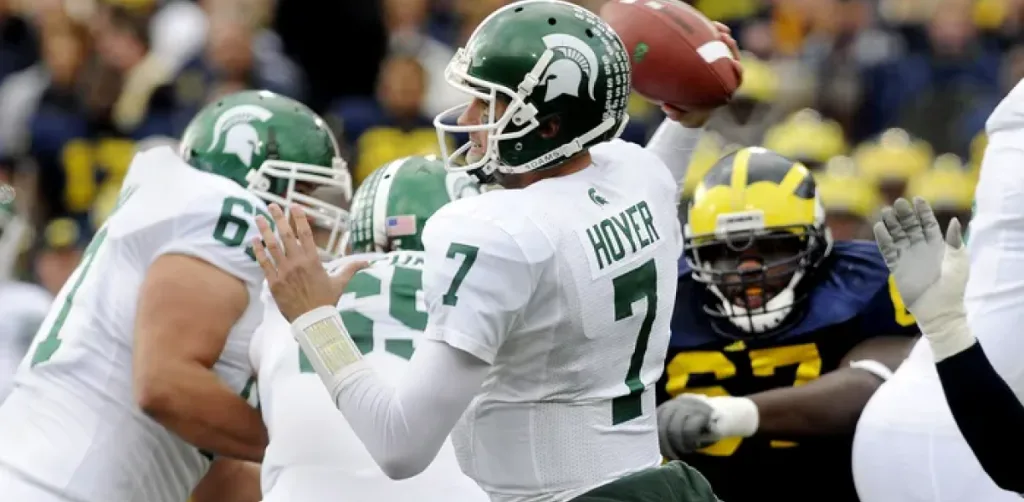
                    Hoyer during his college days at Michigan State.

                    By the time the seventh round had come and gone Hoyer still hadn’t had his name called.

                    By the end of the draft Hoyer had no team and an uncertain future.

                    “At the time I was crushed. I felt rejected and that maybe I had watched a career in football slip away,” he said.

                    “In hindsight, had I gone to some one of these teams that told me they were going to draft me, my career might have lasted a year, two years tops and their coaches all ended up getting fired within a few years of when I got drafted.”

                    As is the case with many undrafted players, opportunities to either train with a team or be signed by a team following the draft can present themselves.

                    While the calls hadn’t come on draft day, they came shortly after.

                    For Hoyer his mindset changed, and the roles had reversed. He now had the chance to pick his team.

                    One of those opportunities was with the New England Patriots.

                    “I wasn’t sure how they would be the best fit for me, I was going to be the fourth string quarterback,” Hoyer said.

                    “They had Tom Brady in his ninth season who’d already won three Super Bowls and is the best quarter back in the league.

                    “My agent helped me realize that worst case scenario, I’d go there, learn from Tom Brady for a year, and you take that with you and try to extend your career elsewhere.”

                    Within a matter of hours Hoyer went from the disappointment of going undrafted to shipping up to Boston.

                    Draft Day Disappointment Just Part of Hoyer’s Journey
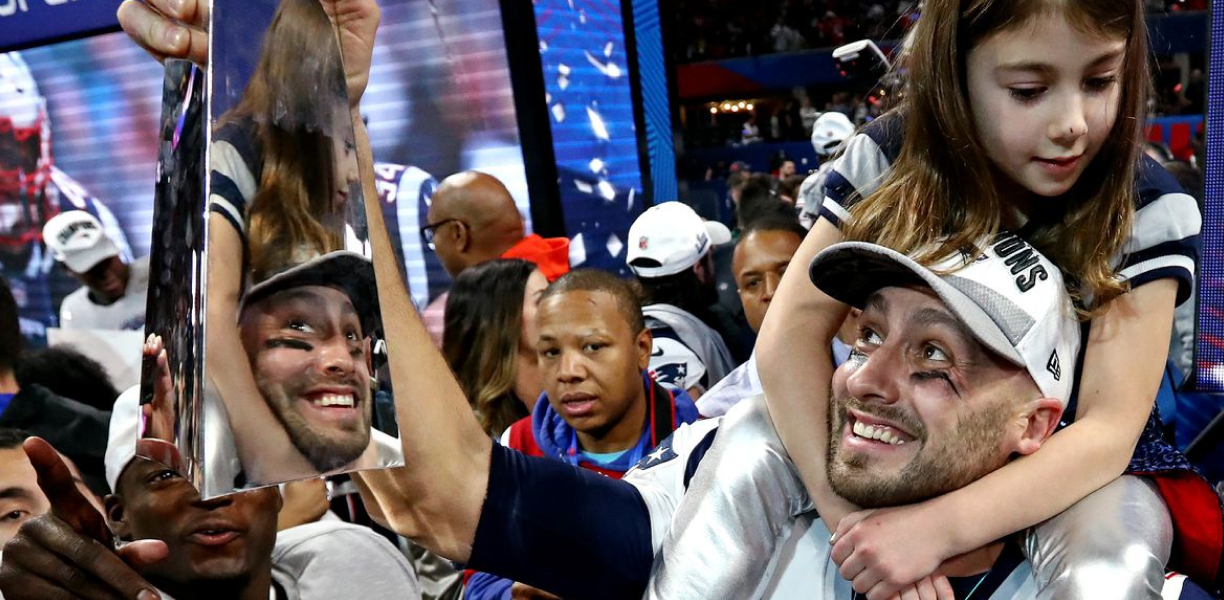
                    Hoyer (right) with Tom Brady (left) during his first season at the Patriots.

                    Hoyer sees it as the best decision he made.

                    “What I learned during those four years at the beginning of my career, being around Tom, being at a great organization and learning from some great coaches, allowed me to extend my career,” he said.

                    “I know now that if I had gone to one of the other teams as the backup quarterback, I could have been forced into playing at an earlier stage, before I had the chance to find my feet, watch and learn, and I could have failed.”

                    The most poignant lesson that he learned was from in some word directly from Brady who famously was taken with pick 199 of the 2000 NFL Draft.

                    “He once said to me: “It doesn’t matter how you start, it only matters how you finish”,” Hoyer said.

                    “Those are words to live by.”

                  2. Stay Present: Ben Smith on Mentally Preparing for Big Games

                    Stay Present: Ben Smith on Mentally Preparing for Big Games

                    Author – Ryan Miller

                    Ryan Miller is OMP’s Head of Content and an award-winning journalist and photographer.

                    What does it take to win an NCAA Ice Hockey National Championship?

                    There are few better people to explain than Ben Smith, a man who appeared in three playoff finals and won two championships with Boston College in 2008 and 2010.

                    As his ala mater Boston College prepare to take on Denver in the National Championship Game, Smith shares how he mentally prepared for the biggest game in College Hockey.

                    “I think generally it’s important to breath when you are feeling stress, nerves, anxiety, etc., or when you feel your mind moving away from the present moment” he said.

                    “Staying in the present for me is the key.

                    “Just enjoy every moment and try not to focus on what happened before or what could happen in the future – taking care of the present moment is all that you can do to achieve those big goals that you’ve fought all season for and are all of a sudden right in front of you.”

                    “I find it helpful to use quick phrases to refocus my thoughts when they are starting to wander.

                    “My favorite is “Right Here, Right Now”, but it could be as simple as “Focus” or “Now”, or whatever works best to you to come back to the present moment.”

                    Across eight seasons in the NHL Smith won Stanley Cup with the Blackhawks in 2013 and a Bronze Medal playing for the US National Team at the 2015 Ice Hockey World Championships.

                    He’s captained the Toronto Marlies to an AHL title in 2018 and also won two German League titles with Adler Mannheim in 2019 and most recently in 2023 with München.

                    Stay Present: Ben Smith on Mentally Preparing for Big Games
                    Ben Smith (second left) celebrates winning the DEL (Germany’s top-flight Ice Hockey League) with Adler Mannheim in 2019.

                    Needless to say, Smith has a great deal of experience dealing with the pressures of big games.

                    “The biggest piece of advice I can give is to enjoy the moment,” Smith said.

                    “If you and your team have gotten to this point you clearly have done something well and have prepared yourself and your team in a way that got you there.

                    “It is normal to feel pressure and to think about the significance of this game, but when the puck drops it is all about instincts and playing the game the way that you have prepared for all season.”

                    Smith’s first final was in 2007, his freshman year, and Boston College would lose to Michigan 3-1.

                    He learned a great deal from that first attempt, and it would help him in the remainder of his college career and then throughout his decorated professional career.

                    “As a freshman, of course I was nervous, but I probably was a bit naive,” he recalls.

                    “We were favored to win the championship and when we lost in the way that we did, it was pretty disappointing, especially for the upperclassmen who had experienced the same thing the year before.

                    “Those feelings didn’t disappear, but with them brought motivation to get back there the next season and get the job done.

                    “The second time around felt easier, having had that big game experience and knowing how the whole Frozen Four weekend plays out.”

                    “Losing isn’t easy but sometimes that’s what it takes to push you and your team to the next level that it takes to win.”

                    Ben Smith’s Athlete Insights series is coming to the OMP App later this year.

                  3. Cognitive Behavioral Intervention Shown to Improve Well-being in Athletes

                    Cognitive Behavioral Intervention Shown to Improve Well-being in Athletes

                    Authors – Vedika Jogani

                    A recent graduate from Ithaca College with a Master’s degree in Sports and Exercise Science, specializing in Mental Performance, Vedika Jogani is OMP’s Product and Content Manager.

                    Ever wondered how young athletes handle the pressure of juggling academics, sports, and the challenges of navigating their adolescence?

                    How do these athletes tackle stress, and is there a secret playbook for them?

                    A 2023 study done in the United Kingdom showed that a six-week cognitive behavioral intervention including stress mindset, ABC thinking, self-compassion and imagery was able to enhance athlete’s psychological well-being and perceived performance.

                    The study uses these approaches rooted in the Rational Emotive Behavioral Therapy approach.

                    Stress Mindset

                    Recent research explores how individuals’ stress mindset—viewing stress as either enhancing or debilitating—shapes outcomes.

                    A positive “stress-is-enhancing” mindset correlates with better psychological and physical health, coping behaviors, and performance in athletes.

                    Conversely, a “stress-is-debilitating” mindset increases the risk of burnout and negative affect.

                    Targeting stress mindset may hold promise for enhancing psychological well-being and performance in athletes. 

                    Irrational beliefs

                    A concept called the Theory of Challenge and Threat States in Athletes (TCTSA-R), looks at how our beliefs influence how we feel and perform.

                    Imagine you face a challenge (A), and based on your beliefs (B), it affects how you feel and act (C).

                    If your beliefs are flexible and realistic, it’s usually good for your well-being and performance.

                    But if your beliefs are rigid and unrealistic, it can lead to negative feelings and affect your performance, especially in sports.

                    For athletes, certain irrational beliefs, like feeling demanding or seeing yourself as a failure if you lose, can mess with their performance and well-being.

                    Instead, seeing stress in a more balanced way can lead to better responses in stressful situations.

                    So, looking at how athletes view stress, and their beliefs together can give us insights into their well-being and performance. 

                    Self-compassion

                    Self-compassion, a powerful strategy, involves three pillars: self-kindness, common humanity, and mindfulness.

                    Self-kindness fosters understanding and acceptance in challenging situations, promoting a positive self-view.

                    Common humanity emphasizes that many individuals share similar feelings during stress, fostering connection.

                    Mindfulness encourages balanced thoughts and feelings, aligning with Rational Emotive Behavior Therapy (REBT).

                    Applied in sports psychology, self-compassion is associated with reduced self-criticism and negative emotions, offering a valuable tool in promoting psychological well-being and performance under pressure. 

                    Imagery

                    Imagery, involving all senses to pre-experience an event, has proven effective in enhancing stress-related outcomes.

                    Recent findings suggest that imagery can also improve stress mindset when combined with stress education.

                    This method helps individuals attach more helpful meanings to stress responses, aligning with the ABC thinking approach and providing a sense of control in situations where changing the event isn’t possible. 


                    In conclusion, this study used a multimodal cognitive-behavioral intervention, delivered toward the end of the competitive season in six one-hour group workshops, aimed to enhance young athletes’ psychological well-being and perceived performance.

                    The intervention incorporated education and reappraisal, focusing on stress mindset, irrational beliefs, self-compassion, and imagery.

                    Results showed that this comprehensive approach could be effective in fostering adaptive views about stress and improving athletes’ mental well-being.

                  4. What is Identity Leadership?

                    What is Identity Leadership?

                    Authors – Vedika Jogani

                    A recent graduate from Ithaca College with a Master’s degree in Sports and Exercise Science, specializing in Mental Performance, Vedika Jogani is OMP’s Product and Content Manager.

                    Ever wondered about the magic behind a team’s success and how effective leaders contribute to it?

                    The way leaders embody the values of a team can make a significant impact on the team’s inspiration and success.

                    The influence of a good leader is truly immense and can change the nature and culture of the team.

                    A study done in the UK in 2023 highlights that effective leaders not only embody the values of the group but also create a shared identity, a concept known as “identity leadership.”

                    This means that leaders who exemplify and represent the team’s values can inspire their followers. 

                    The Social Identity Approach

                    In sports psychology, the social identity approach says people see themselves as both individuals and part of a group, especially in a sports team.

                    Identity leadership is when leaders create and represent this shared identity.

                    When leaders do this, they become part of the group, making their team trust them more, and this trust helps them inspire the team better. 

                    A series of two studies dived deeper into this identity leadership and its impact on the trust of teammates.

                    The first study found that when leaders embody identity principles, it directly boosts followers’ inspiration.

                    These four principles also boost inspiration by building trust in the leader:

                    Identity Prototypicality: This involves representing the unique qualities that define the group, emphasizing a sense of belonging. 

                    Identity Advancement: This principle focuses on advancing and promoting the core interests of the group, fostering a collective sense of purpose. 

                    Identity Entrepreneurship: It involves bringing people together by creating a shared sense of “we” and “us” within the group, fostering unity. 

                    Identity Impresarioship: This principle is about developing structures, events, and activities that give weight to the group’s existence and allow members to live out their membership, highlighting the significance of the group.
                    The study emphasizes how important identity leadership is for inspiring teams and suggests that feeling connected and trusting the leader are key reasons for this. 

                    The second study found that two aspects of leadership, specifically making the group matter (advancement) and organizing important activities (impresarioship), were connected to how inspired team members felt later on. Interestingly, this link was influenced by how much the team trusted their leader. So, when the leader was seen as trustworthy, it made the athletes feel more inspired over time.

                    This study says that when leaders show they care about the team and organize important things, it inspires the team.

                    Trust in the leader is key for this inspiration.

                    So, it suggests that if leaders work on these aspects, they can positively impact how much the team trusts them and, in turn, how inspired the team feels.

                    All of these have ripple effects on the team’s performance.

                  5. Sharks Sharpening Mental Skills with OMP

                    Sharks Sharpening Mental Skills with OMP

                    Australian rugby league club the Cronulla-Sutherland Sharks have become the first professional team to partner with Optimize Mind Performance.

                    The Sharks, who compete in the National Rugby League, Australia’s premier rugby league competition, will use OMP’s game-changing mental skills training platform across their NRL, NRLW and under-age pathway programs.

                    Their men’s team has already started engaging with OMP’s sport-specific content as they prepare for the 2024 NRL Telstra Premiership season.

                    The Sharks’ high-performance team, led by NRL Head Coach Craig Fitzgibbon and General Manager Football Darren Mooney, recognise the importance of mental skills training and the need to invest in this area of athletic performance.

                     “We at the Sharks believe for us to perform at a higher standard we must be mentally as well as physically prepared for the rigours of elite sport,” Fitzgibbon said.

                    “OMP is a game-changer for us, as it gives all of our athletes the opportunity to train their minds and be ready for the season ahead.”

                    Mooney added: “We are fostering a culture at the Sharks where training the mind is being prioritised along with physical training.

                    “With OMP we can seamlessly embed it into the players’ weekly training schedule.”

                    Founded in Australia and crafted by a network of experts in mental performance, OMP is being used by sporting programs at the University of Nebraska-Lincoln and University of Louisville Athletics in the US.

                    Optimize Mind Performance CEO & Founder Jack Preddey said: “We’re delighted to welcome the Sharks to the OMP Team as our first professional organisation. They have a great understanding and recognition that mental skills training needs to be proactively included in their performance programs which we are excited to assist them with.”

                    Entering the competition in 1967, the Sharks won their first premiership in 2016, and since 2012 have only missed the NRL finals (playoffs) twice.

                    In 2023 they made the elimination final and will be looking to push further in 2024 as they hunt their second premiership.

                    Contact the OMP Team
                    +61 0419 926 089 | +1 617 608 7967 | [email protected]

                  6. Athlete Identity: Impacts on Health & Happiness

                    Athlete Identity: Impacts on Health & Happiness

                    Authors – Vedika Jogani

                    A recent graduate from Ithaca College with a Master’s degree in Sports and Exercise Science, specializing in Mental Performance, Vedika Jogani is OMP’s Product and Content Manager.

                    Ever thought about what keeps athletes hooked on sports? Is it something in their personality, or does it develop as they spend time in the game?

                    In a study from 2024, researchers looked into the connection between how athletes see themselves and why they stick with sports.

                    This exploration goes beyond just physical fitness, affecting their self-esteem, motivation, skills, appearance, success, and even how they think they perform. 

                    Being an athlete is more than just wearing a sports jersey; it involves a mix of different aspects of a person’s mind.

                    Research shows that having a strong athlete identity is linked to more exercise, being social, and better overall health.

                    This identity goes beyond the sports field and affects things like confidence, mental health, and how someone deals with challenges like feeling down. 

                    This athlete’s identity isn’t just about personal qualities; it also affects how someone thinks and behaves in different situations, both in and out of sports.

                    So, figuring out athlete identity is crucial to understanding all the different parts that make up an athlete’s well-being. 

                    Passion 

                    Passion in sports is more than just liking something; it’s a strong force that pushes athletes to succeed.

                    It’s a deep love and motivation that makes people not only spend time but put their real heart into the activities they love.

                    This passion is a key factor in overcoming challenges and achieving success in sports. 

                    Studies show a connection between passion in sports and how well athletes perform.

                    This intense love for sport becomes a source of energy and determination, helping athletes through tough training and competitions.

                    The complex link between passion, identity, and different outcomes, both in feelings and actions, adds another layer to understanding who a person is. 

                    Dedication 

                    Being dedicated to sport means sticking with it for the long haul.

                    It’s about consistently believing in it, putting in effort, enjoying it, and having a positive mindset.

                    Dedication goes beyond just spending time and energy; it’s a mindset that includes energy, commitment, and staying true to something. 

                    This dedication, connected to the Social Exchange Theory, is crucial for athletes to stay in sports for a long time.

                    It becomes a lasting mix of thoughts and feelings, including confidence, commitment, energy, and enthusiasm.

                    Understanding dedication helps us see how an athlete’s commitment connects to their success. 


                    This study dives deep into understanding athlete identity, passion, and dedication.

                    It explores how dedication works as both a helper and a manager in the connection between loving sports and being an athlete.

                    The numbers show positive results: loving the sport has a good impact on being an athlete, and dedication makes this impact even stronger. 

                    But it’s not just a one-way street. Being an athlete also has a positive effect on both loving the sport and being dedicated.

                    The study points out the big role dedication plays, emphasizing how it affects athletes’ thoughts and long-term success in sports. 

                    Really liking a sport directly affects being an athlete.

                    Liking it too much might cause some problems, but when it’s channeled in a positive way, it leads to better performance, motivation, and managing goals.

                    Dedication is shown to have a direct positive effect on an athlete’s personality, showing how important it is in shaping commitment and success. 

                    What’s more, the study confirms that dedication acts like a middleman and manager in how loving a sport affect being an athlete.

                    This interplay between passion, dedication, and identity isn’t just one-way.

                  7. The What, Why and How of Goal Setting

                    The What, Why and How of Goal Setting

                    Authors – Vedika Jogani

                    A recent graduate from Ithaca College with a Master’s degree in Sports and Exercise Science, specializing in Mental Performance, Vedika Jogani is OMP’s Product and Content Manager.

                    In high performance, goal setting is a potent and transformative technique.

                    While extensive research has explored SMART goals and various goal-setting acronyms, there remains a notable gap in understanding the intricate process and the nuanced ‘how’ behind it all.

                    A recent, 2023, study compared goal-setting models, revealing that this complex practice can be distilled into four key stages: preparation, goal setting, and meticulous planning, all followed by a strategic and deliberate follow-up. 

                    1. Preparation

                    This stage involves performance profiling, emphasizing collaboration and analysis.

                    The process includes understanding long-term vision, connected to goal motives, and education stages rooted in psychological skills training.

                    There is a focus on the involvement of a social agent, like a coach, to enhance effectiveness.

                    Educating athletes about effective goal setting is considered a vital step, enhancing self-regulation and autonomy.

                    The multifaceted nature of goal setting, encompassing individual and team aspects, highlights the need for tailored approaches and understanding the diverse factors influencing the effectiveness of the goal-setting process. 

                    2. Goal Setting

                    Empirical evidence suggests specific goals may not be superior to nonspecific ones, and specific, difficult goals might be less effective than specific, moderate goals.

                    Despite the evolving nature of goal-setting theory, specific, challenging goals persist.

                    Most processes encourage setting multiple goals, but guidance on the number of goals is lacking.

                    Prioritizing goals, often through ranking by importance, is common, with some models offering comprehensive frameworks for goal prioritization.

                    The need for a goal ranking/prioritization stage can potentially be minimized by conducting a quality needs analysis, preventing overly broad goal setting. 

                    3. Planning

                    In this stage, commitment is vital, driven by an individual’s determination linked to goal difficulty.

                    Strategies like athlete involvement, incentives, and public disclosure enhance commitment, emphasizing ownership and mission identification.

                    Processes involve strategies and barrier recognition, addressing internal and external factors. Feedback, particularly with measurable goals, is crucial for motivation and strategy evaluation.

                    Combining goals with feedback is effective, and interventions incorporating self-monitoring show short-term positive impacts on training adherence. 

                    4. Feedback

                    In the pursuit of goals, adapting and refining them is crucial for success.

                    Rather than persisting blindly, smart adjustments along the way are essential.

                    Letting go of unrealistic goals can be a positive, protective move, shielding against emotional tolls.

                    Practitioners should be mindful of goal-revision processes during the journey.

                    Positive reinforcement is also key, motivating athletes by recognizing their efforts and achievements.

                    However, coaches must be strategic in using tangible rewards, ensuring they don’t unintentionally stifle intrinsic motivation.

                    It’s a delicate balance between external recognition and internal drive. 


                    In conclusion, the study sheds light on the intricate process of goal setting in the realm of high performance.

                    The four key stages—preparation, goal setting, planning, and follow-up—underscore the complexity and depth involved.

                    Coaches and practitioners should keep these strategies in mind while helping athletes set goals for its most effective use.